


Why Choose Our Jewish Wedding Speech Generator
Cultural Authenticity
Our AI helps you thoughtfully incorporate Jewish traditions, values, and blessings that honor the rich heritage of Jewish weddings while remaining authentic to your voice.
Hebrew Integration
Include appropriate Hebrew phrases and blessings with proper transliteration and explanations, adding a meaningful layer of tradition to your wedding speech.
Inclusive Approach
Create a speech that beautifully honors Jewish traditions while remaining accessible and meaningful to all wedding guests, regardless of their background.
Hear From Others Who Created Jewish Wedding Speeches
"I wanted to incorporate Jewish traditions and wisdom into my best man speech without being too formal. WedSpeech.ai helped me balance humor with meaningful references to Jewish values of family and commitment."
David K.
The Ultimate Jewish Wedding Speech Guide
What Makes a Great Jewish Wedding Speech
A Jewish wedding speech blends warmth, humor, and blessing. It often honors the couple, reflects on the chuppah and the day's meaning, and closes with 'Mazel tov' and a l'chaim. Jewish tradition has always mixed joy with a good story.
Keep it warm and light, with room for a genuine blessing. Jewish weddings love a well-told story and a toast. Five to seven minutes is right, and a little humor is welcome.
A Simple Jewish Wedding Speech Outline
- Opening: greet the guests (about 30 seconds).
- A reflection on the chuppah or the day's meaning (about 45 seconds).
- A story about the couple (about 90 seconds).
- A blessing for their future (about 30 seconds).
- Toast with Mazel tov and l'chaim (about 20 seconds).
Essential Elements of a Great Jewish Wedding Speech
- Open warmly: Greet the guests and both families. A warm start sets the tone for the joy that follows.
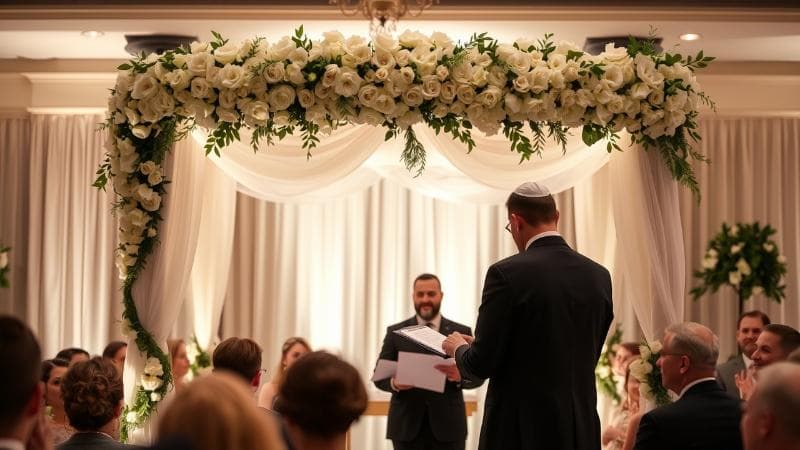
- Reflect on the chuppah or the day: Speak to what the chuppah represents: the home they will build together, open on all sides. A short reflection grounds the speech.
- Tell a story about the couple: Jewish tradition loves a well-told story. Pick one that shows their character and ends with a smile.
- Offer a blessing: A short, sincere blessing for their life together. A Torah verse or a traditional blessing works beautifully.
- Use the traditions naturally: Mazel tov, l'chaim, and other familiar words belong here. Use them warmly, not as decoration.
- Keep the humor warm: Jewish humor is a tradition of its own. Warm, self-aware humor fits perfectly.
- End with Mazel tov: Close with 'Mazel tov' and raise the glass for a l'chaim.
Tips for Delivering a Memorable Jewish Wedding Speech
- Honor both families early in the speech.
- Include the traditional words: Mazel tov, l'chaim.
- A short Torah verse or blessing, in plain words, works beautifully.
- Keep the humor warm and self-aware.
- Reflect on the chuppah and what it represents.
- Keep it under seven minutes.
- Practice any Hebrew so you say it right.
- End with Mazel tov and a raised glass.
Common Jewish Wedding Speech Mistakes to Avoid
- Skipping the traditional words entirely.
- Using humor that punches down.
- Making it a lecture instead of a celebration.
- Forgetting to honor both families.
- Going long.
- Mispronouncing the Hebrew or Yiddish.
- Forgetting the l'chaim toast.
- Ending without Mazel tov.
Frequently Asked Questions
What should a Jewish wedding speech include?
A warm greeting, a reflection on the chuppah, a story, a blessing, and a close with Mazel tov and l'chaim.
What does Mazel tov mean?
It means congratulations or good fortune, and it is the traditional way to wish the couple well.
What does l'chaim mean?
It means 'to life,' and it is the traditional toast, said while raising a glass.
How long should it be?
Five to seven minutes. A story, a blessing, and a toast is all the room needs.
Should I use Hebrew or Yiddish?
A few familiar words like Mazel tov and l'chaim are expected and welcome. Practice the pronunciation.
Can I use humor?
Yes, warm and self-aware humor is a Jewish tradition of its own. Keep it kind.
What is the chuppah?
The canopy the couple stands under during the ceremony, symbolizing the home they will build together, open on all sides.
What should I avoid?
Skipping the traditional words, punching-down humor, lecturing, and mispronouncing the Hebrew.
How do I end it?
With Mazel tov and a raised glass for l'chaim.
Do I need to honor both families?
Yes, and early. Both families are central to the day.